
For students, educators, and robotics enthusiasts, Spring 2026 Ftc Prep Class and VEX Robotics Competition (VRC) are two of the most well-respected robotics programs. Both provide hands-on experience in designing, building, and programming robots, but they differ significantly in flexibility, programming capabilities, cost, awards, soft skills development, and name recognition.
While both programs offer valuable learning opportunities, FTC provides more creative freedom, stronger programming capabilities, and greater industry recognition, while VEX offers a structured, cost-effective approach to competitive robotics.
If you’re deciding which program is right for you, here’s a breakdown of the key differences.
Flexibility and Creativity in Robot Design
FTC: More Freedom to Innovate
FTC allows for a high degree of customization, enabling teams to explore real-world engineering solutions. Teams can use parts from multiple vendors, including REV Robotics, Tetrix, and GoBilda, and even design custom components using 3D printing, CNC machining, and laser cutting.
Electronics & Sensors: FTC robots are powered by an Android-based control system, which supports advanced sensors, AI, and vision processing.
Customization: Teams can create fully unique mechanisms, encouraging problem-solving and critical thinking.
VEX: Standardized and Accessible
VEX follows a more structured approach, requiring teams to build robots using only VEX-manufactured parts. This ensures accessibility and uniformity but limits design flexibility.
Electronics & Sensors: VEX robots use the VEX V5 system, which is user-friendly but lacks the advanced capabilities of FTC.
Customization: Teams must work within a defined set of parts, making creativity more about optimization rather than innovation.
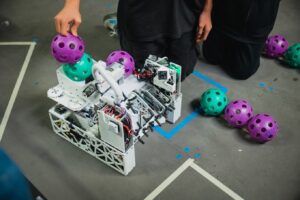
🔹 Verdict: If you enjoy custom engineering and innovation, FTC offers greater design freedom. If you prefer a structured, pre-defined system, VEX may be a better fit.
Programming Capabilities
FTC: Advanced AI and Custom Coding
- FTC supports:
Java (FTC SDK) for professional-grade programming. - OnBot Java and Blocks for beginners.
- AI and vision processing using TensorFlow and OpenCV.
- Wireless debugging with Android-based controllers.
This gives students real-world coding experience in automation, AI, and robotics engineering.
VEX: Simplified but Functional
VEX robots are programmed using VEXcode, which supports:
C++, Python, and Blocks.
Limited AI and vision processing.
While VEX provides a solid foundation in coding, it lacks the depth and flexibility of FTC’s programming options.
🔹 Verdict: FTC is the better choice for students looking to develop advanced coding skills, while VEX provides a more structured but limited programming experience.
Cost Comparison
| Factor | FTC | VEX |
| Initial Cost | $1,500–$3,000 | $1,000–$1,500 |
| Customization | 3D printing, custom parts allowed | Only VEX parts allowed |
| Sensors & AI | Advanced vision processing | Basic automation only |
| Long-term Investment | More expensive, but allows for innovation | Lower cost, standardized parts |
🔹 Verdict: VEX is more budget-friendly, but FTC provides better long-term value due to its greater customization and engineering depth.
Soft Skills Development: FTC vs. VEX
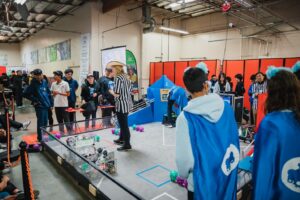
Beyond technical skills, robotics programs help students develop soft skills, such as teamwork, leadership, communication, and problem-solving. While both FTC and VEX offer these opportunities, FTC emphasizes a broader skill set that aligns with leadership and real-world STEM careers.
FTC: Holistic STEM and Leadership Development
FTC encourages students to develop:
✅ Collaboration & Leadership – Teams work closely, assigning specific engineering, programming, and outreach roles.
✅ Project Management – Engineering notebooks, iterative design processes, and documentation mirror real-world engineering workflows.
✅ Public Speaking & Networking – FTC emphasizes community outreach, requiring teams to present their work to judges, industry professionals, and other teams.
✅ Entrepreneurial Thinking – Teams often fundraise, seek sponsorships, and promote STEM education.
✅ Resilience & Adaptability – Robots must be modified constantly based on real-time testing and competition performance.
VEX: Competitive Focus with Teamwork
VEX also develops soft skills but with a stronger emphasis on competition rather than outreach and leadership.
✅ Strategic Thinking – Since VEX focuses more on match play, teams analyze opponents and refine strategies.
✅ Time Management – With limited resources, teams must optimize robot designs efficiently.
✅ Teamwork – Like FTC, VEX requires collaboration, but with a greater focus on game performance rather than project-based teamwork.
🔹 Verdict: FTC provides a well-rounded experience, developing leadership, project management, and communication skills, while VEX is more focused on teamwork within a competitive setting.
Name Recognition Among Colleges & Industry
FTC: Strong College & Industry Recognition
FIRST is widely recognized by top universities, including MIT, Stanford, and Carnegie Mellon.
FIRST offers over $80 million in scholarships, exclusively for FTC and FRC students.
Major companies like Google, NASA, Qualcomm, and Boeing actively support FTC.
VEX: Growing but Less Recognized
Some universities (Purdue, Texas A&M) recognize VEX, but it isn’t as well-known in college admissions as FIRST.
VEX alumni often excel in mechanical and competition-based skills, but industry networking opportunities are more limited.
🔹 Verdict: FTC has stronger college and industry recognition, making it the better choice for students looking to leverage robotics for scholarships and career opportunities.
Final Thoughts: Which One Is Right for You?
| Factor | FTC (FIRST Tech Challenge) | VEX (VEX Robotics Competition) |
| Robot Design | High flexibility (custom parts allowed) | Standardized parts (VEX only) |
| Programming | Advanced (Java, AI, TensorFlow) | Simplified (C++, Python) |
| Cost | Higher ($1,500–$3,000) | Lower ($1,000–$1,500) |
| Soft Skills | Leadership, communication, outreach | Teamwork, competition |
| College & Industry Recognition | Highly valued by top universities & companies | Recognized, but not as extensive as FTC |
Both FTC and VEX provide valuable STEM learning experiences, but FTC stands out for its creative freedom, stronger programming capabilities, and broader soft skills development. Summer Robotics Programs is a great option for those who prefer a structured, competitive robotics experience with a lower cost barrier.
Ultimately, Spring 2026 Ftc Prep Class is the better choice for students looking to develop engineering skills, gain leadership experience, and stand out in college applications, while VEX is ideal for those who enjoy competition-focused robotics within a structured system.
Which one is right for you? Explore both programs, talk to teams, and choose the path that aligns with your goals!
One Response
Great content! Keep up the good work!