What Does Effective Teamwork Look Like?
“Teamwork” is something we ask FLL students to practice all the time. But for young students, the word can be vague.Does teamwork mean everyone has to agree? Does everyone need to do the same amount of work? Should every student build, code, research, and present equally? Not really.
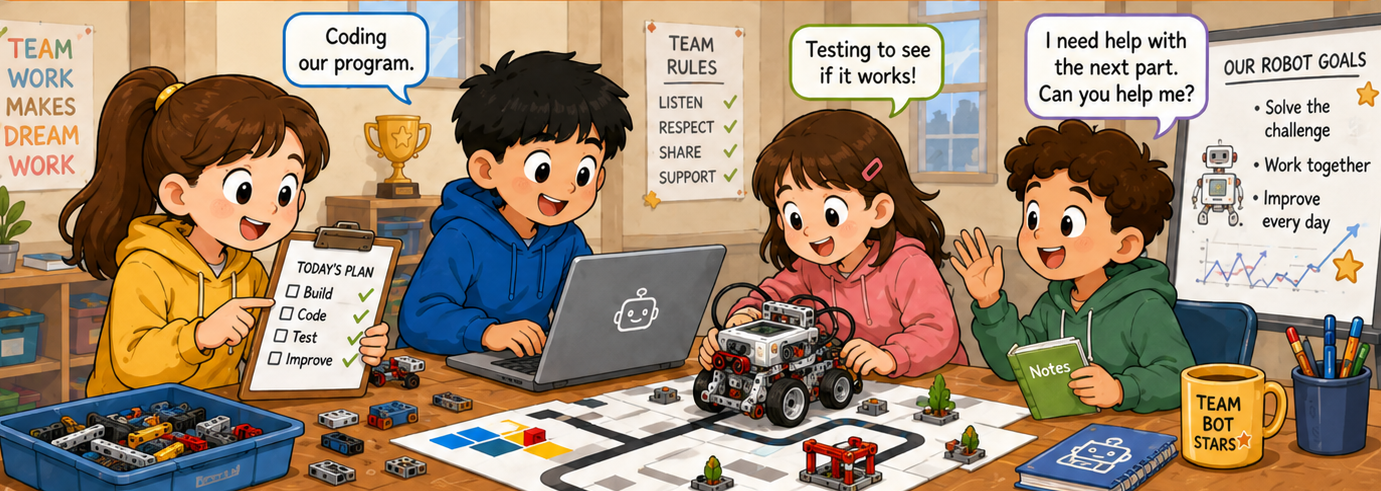
Effective teamwork is simply a group of students learning how to accomplish something together that would be difficult for one person to do alone. For elementary and middle school students, especially in educational robotics for kids, that is a learned skill. We should not expect them to already know how to do it.
Everyone Does Not Have to Do Everything
Good teams naturally develop different strengths. One student may enjoy programming, another may be better at building, while another is strong at research or presenting.
Fairness does not mean every student spends exactly the same amount of time on every task. What matters is that everyone makes a meaningful contribution and understands what the team is working toward. Students should still learn from one another and try things outside their comfort zone. But specialization is not poor teamwork. It is how most real teams work.
Take Ownership
One of the biggest steps in developing teamwork is learning to take responsibility without constantly being reminded.If a student agrees to test an attachment, research a question, or work on a presentation, the expectation is simple: Remember what you agreed to do, make a reasonable effort to do it, and ask for help when you need it. For a 10- or 12-year-old, this is an important part of robotics training for children. Good FTC and FLL competitive team coaching gives students a safe place to practice responsibility, make mistakes, and improve.
Communicate When Something Is Not Working
Good teamwork does not mean solving every problem by yourself. Students should learn to speak up when they are stuck, confused, or unable to finish something. A useful rule is: Say what you will do. Try to do it. Speak up if you need help.Those three habits prevent many team problems.
Disagreement Is Normal
A team that disagrees is not necessarily a dysfunctional team. Students will have different ideas about designs, strategies, programs, and presentations. The important skill is learning how to disagree productively. Instead of focusing on whose idea is “right,” students can explain their reasoning, listen to others, test different options, and use evidence to make decisions. In robotics, sometimes the best way to settle an argument is simply to build it and test it.
Make Space for Other People
Teamwork requires two skills that seem almost opposite. Strong or experienced students need to learn when to step back and let someone else try. Quieter students need to learn when to step forward and contribute.A student who can finish something faster does not always need to do it personally. Sometimes helping a teammate learn is more valuable.At the same time, students should practice asking questions, volunteering, and sharing their ideas instead of always waiting to be invited.
Don’t Keep Score Too Closely
Children sometimes focus on whether everyone is doing exactly the same amount of work.Real teamwork rarely works that way.Different students contribute in different ways and at different times. One task may take much longer than another even if it looks smaller. Persistent participation problems should be addressed, but the goal is not perfect equality. The goal is shared responsibility and meaningful contribution.
How Parents Can Help
Parents have an important role because many FLL students are doing serious team-based work for the first time. The key is to scaffold rather than solve. Instead of immediately telling a child what to do, ask questions:
What did your team decide?
What are you responsible for?
Have you told your teammates you need help?
What could you try next?
Parents can also help younger students with organization. A calendar, reminder, or checklist may be useful at first. Over time, students should gradually take over these responsibilities themselves.The same applies to conflict. If a child complains about a teammate, it may be tempting for a parent to immediately intervene. Unless the situation is serious, first help the student think about how they might address the problem themselves. The goal is not to remove every difficult situation. It is to give children enough support to learn how to handle those situations.
What Good Teamwork Really Looks Like
A good FLL team is not one where everyone agrees and nothing goes wrong. It is a team where students gradually learn to:
contribute meaningfully,
take responsibility,
communicate when they need help,
listen to different ideas,
resolve disagreements,
teach and learn from one another,
and rely less on adults to manage the team.
That process can look messy, and that is normal. FLL teamwork is not about creating a perfectly functioning team of 10-year-olds. It is about giving young students repeated opportunities to practice skills they will need in school, work, and life.
A LEGO robotics program prepares students by giving them something concrete to work on through the robot and Innovation Project. Learning how to work with other people is the bigger lesson.